
Method: Follicular Unit Extraction
Most Popular Choice
Approach: Doctor-Led
Cost: £3,000 – £7,000
Finance Available
FUE Hair Transplant




GMC-Registered Surgeons
Every procedure at our Birmingham clinic is carried out by a GMC-registered doctor
Birmingham City Centre
Centrally located and easily accessible from across the Midlands by road and rail
Free No-Pressure Consultation
A candid assessment of your donor hair and realistic outcome, no hard sell
Dedicated Per-Patient Care
Your surgeon is focused on your case alone, from the first extraction to the last graft implanted
FUE Hair Transplant Birmingham
If you are considering an FUE hair transplant in the West Midlands, our Birmingham clinic performs surgeon-led follicular unit extraction (FUE) procedures designed to restore hair naturally, safely, and permanently. FUE is one of the most advanced hair transplant techniques available, delivering natural-looking density with minimal scarring and downtime. Book a free consultation today with one of our patient advisors.
Before and After FUE Hair Transplant Results in Birmingham
A selection of results from patients treated at our Birmingham clinic. All procedures were performed by our GMC-registered surgeons.
What is an FUE Hair Transplant?
Follicular Unit Extraction (FUE) is a modern hair transplant technique where individual hair follicles are carefully extracted from a donor area (i.e. the back or sides of the scalp) and implanted into areas affected by hair loss.
FUE can be used in a number of different situations to restore hair on the scalp, beard, or eyebrows. It is most commonly used to reverse signs of male pattern baldness (androgenic alopecia). Pattern hair loss is usually categorised as having temple recession and thinning hair on the crown. Hairline and crown FUE surgeries are the staple of our Birmingham hair loss clinic.
At the Birmingham hair transplant clinic, all FUE hair transplants are performed by one of our experienced surgeons, performing extractions, incisions, as well as assisting technicians with implantations.
Unlike older methods, FUE does not require a linear incision or “strip scar”, making it the preferred option for many of our patients who are seeking minimal scarring, a fast recovery time, and natural looking results.
FUE Hair Transplant Procedure in Birmingham (Step-by-Step)
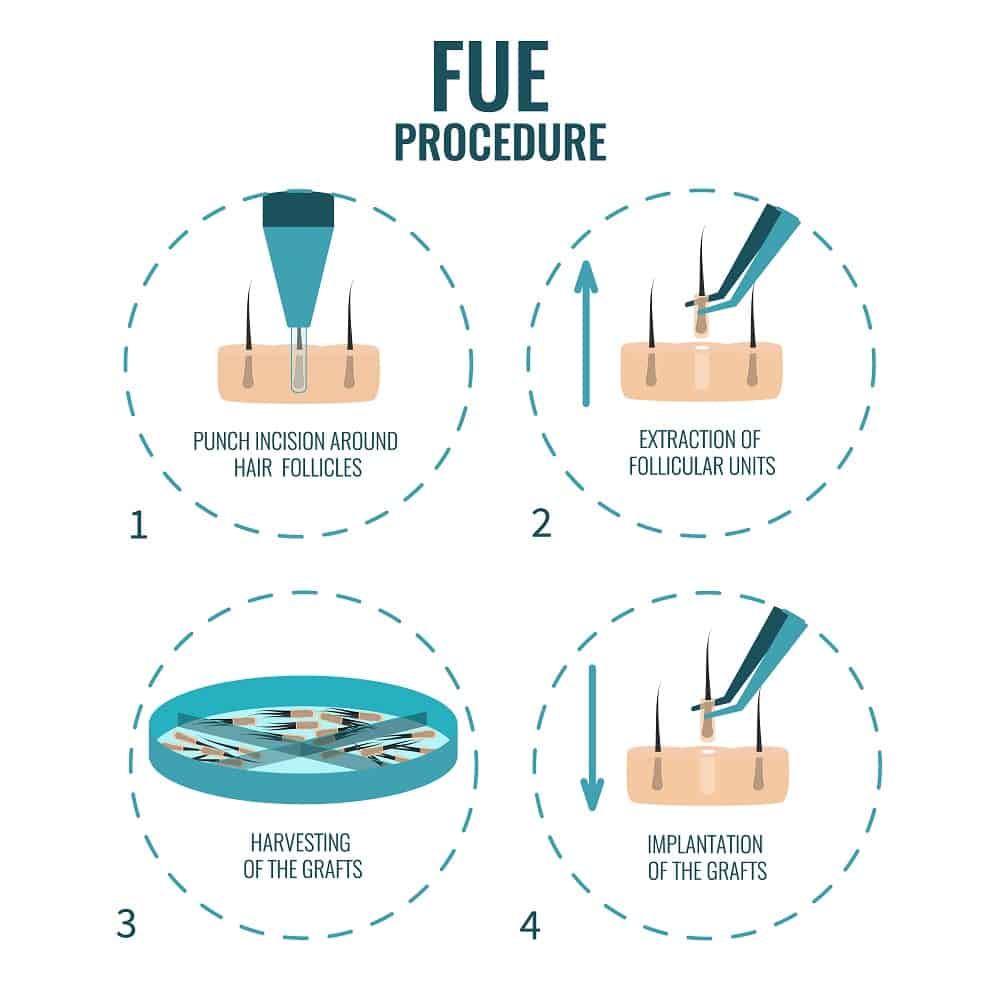
FUE hair transplants can be split into three separate phases: incisions, extractions, and implantations. In this section, we will walk you through an FUE procedure, from the moment you enter the Birmingham clinic to the moment you leave.
Prior to the day of surgery, you will have had your initial consultation with our patient advisor, received your personalised treatment plan, and been booked in for your hair transplant.
Pre-Surgery Consultation
Once you have arrived at the clinic in Birmingham, you will have a pre-surgery consultation with your hair transplant surgeon to finalise your aims and expectations for the treatment. From here, you will decide on your final hairline design and the surgeon will administer local anaesthetic and saline solution onto your scalp.
Extraction Phase (Donor Area)
The first main stage of an FUE procedure are the extraction of grafts from the donor area. During the extraction phase, hair follicles are extracted individually using a precise micro-punch tool. During this part of the procedure, the surgeon and technicians are all hard at work.
The donor area is typically located at the back and sides of the scalp, where hair follicles are more genetically resistant to DHT, the hormone responsible for androgenetic hair loss. These follicles retain their resistance even after being transplanted to thinning or bald areas. That makes them ideal for hair restoration surgery.
Individual follicular units (containing 1–4 hairs) are extracted one by one using micro-punch tools, usually measuring between 0.6 mm and 1.0 mm in diameter. At the Birmingham hair loss clinic, this part of the procedure is always performed by the surgeon.
The surgeon must carefully align the punch with the natural angle and depth of each follicle to avoid transection (damage to the follicle). This step requires advanced skill, as hair follicles do not grow straight beneath the skin.
While the surgeon extracts healthy hair follicles from the donor area, the technicians (usually 2 or 3 depending on the size of the surgery) are responsible for counting, categorising, and storing useable grafts.
Incision Phase (Recipient Area)
The incision phase is one of the most important parts of any hair transplant procedure. While graft survival determines whether transplanted hair will grow, the placement of incisions will determine how natural your hair transplant will look 12 months down the line.
During this stage, Tiny recipient sites are created using ultra-fine blades or needles, often measuring between 0.7 mm and 1.1 mm, depending on graft size and hair calibre. At the Birmingham hair transplant clinic, we offer the option of steel or sapphire surgical blades.
Each site is individually planned and created to accommodate:
- The number of hairs in the graft
- The thickness of the hair shaft
- The scalp’s elasticity
- The surrounding native hair
Sites must be created before implantation to ensure consistency in direction and spacing. This is what separates follicular unit extraction (FUE) from direct hair implantation (DHI).
Implantation Phase (Recipient Area)
After the recipient sites have been prepared, each follicular unit is placed individually into the prepared sites using forceps or implanter tools. Single-hair grafts are typically used at the hairline, while multi-hair grafts are placed further back for density.
During implantation, the surgeon takes care to:
- Minimise time grafts spend outside the body
- Avoid compression or dehydration
- Maintain consistent spacing for even coverage
This meticulous placement is what allows FUE hair transplants to produce soft, natural hairlines and realistic density. This part of an FUE hair transplant is performed by the whole surgical team (surgeon and technicians).
Consistent spacing and accurate placement ensure even coverage and natural layering across the treated area. This stage brings together all previous planning and technical steps, allowing FUE hair transplants to produce natural hairlines, realistic density, and long-lasting results when performed correctly.
Initial Recovery Period and Hair Growth
As part of your treatment plan, all patients who have an FUE hair transplant at the Birmingham clinic are provided with an aftercare instructions, a recovery kit, and free access to our aftercare app. All patients will have online follow-up consultations at 2 weeks, 3, 6, and 12 months.
Why Choose an FUE Hair Transplant Procedure in Birmingham?
Choosing the Birmingham clinic to perform your FUE hair transplant means you’ll be prioritising patient care and natural looking results. You can book in for a free online or face-to-face consultation with our patient advisors an receive an accurate assessment, realistic planning, and clear expectations from the outset.
Being treated locally in Birmingham also means you will have access to ongoing aftercare and follow-up appointments, which are essential for tracking your healing and progress. During the recovery period, reduced travel stress helps also helps minimise discomfort and lowers the risk of complications during the initial recovery period, allowing you to focus fully on healing.
All of our surgeons at the Birmingham clinic are not only on the GMC medical register, but have additional accreditation from the International Society of Hair Restoration Surgery (ISHRS). This means you will have an experienced, world-renowned surgeon performing your procedure.
FUE Hair Transplant Cost in Birmingham
At our clinic in Birmingham, most of the hair transplants we perform on a daily basis cost somewhere in the region of £3,000 to £7,000, depending on the size and complexity of the case. The cost of an FUE hair transplant varies due to:
- Number of grafts required
- Size of the treatment area
- Hair thickness and density
- Complexity of hairline restoration
All information relating to cost will be discussed during your free consultation and your price quote will be disclosed in your personalised treatment plan. We also have finance plans available to help you pay for your hair transplant over 11 months.
Book Your Free Consultation Today For an FUE Hair Transplant Surgery in Birmingham
If you are researching FUE hair transplant clinics in Birmingham and considering a surgery, the next step is a professional consultation with one of our patient advisors. We’ll consider your aims and expectations and provide you with a personalised treatment plan.
You can contact us on:
- Email: use our contact page
- Phone: +441217511597
Frequently Asked Questions (FAQs)
An FUE hair transplant procedure is generally not painful, as it is carried out under local anaesthetic. The scalp is fully numbed before both the extraction and implantation stages begin, meaning patients remain comfortable throughout the treatment.
You may feel mild pressure or movement during the procedure, but sharp pain is uncommon. After the anaesthetic wears off, some patients experience temporary soreness or tightness in the scalp, which is typically mild and manageable with standard pain relief.
Initial recovery after an FUE hair transplant usually takes 7 to 10 days, during which time redness and small scabs around the transplanted grafts gradually heal. Most patients can return to non-physical work within a few days.
The transplanted hairs often shed within the first few weeks, which is a normal part of the process. New hair growth typically begins around 3 to 4 months, with visible improvement continuing over time. Final results are usually seen between 9 and 12 months following the procedure.
Yes, FUE hair transplants are considered permanent. The transplanted hair follicles are taken from areas of the scalp that are genetically resistant to hair loss, most commonly the back and sides of the head.
Once implanted, these follicles retain their resistance and continue to grow in their new location. While existing non-transplanted hair may continue to thin over time, the transplanted hair itself is designed to provide long-term, lasting results.
If you are young and/or have a family history of hair loss, you may be required to take a hair loss medication (e.g. finasteride/minoxidil). This will help prevent further hair loss after your hair transplant in Birmingham.
You may be a good candidate for an FUE hair transplant if you have sufficient donor hair, stable hair loss, and are in good general health. FUE is suitable for both men experiencing pattern hair loss, thinning hair, or receding hairlines. It is also suitable for women wanting hairline lowering.
Factors such as hair density, scalp condition, age, and future hair loss progression are carefully assessed during a consultation. A professional evaluation is essential to determine whether a transplant is appropriate or whether alternative hair loss treatments may be recommended.
In cases of extensive hair loss, more than one FUE hair transplant may be required to achieve optimal coverage and density. This depends on the size of the balding area, the number of grafts needed, and the capacity of the donor area.
Performing treatment in stages allows for careful donor management and natural-looking results while preserving options for future hair restoration. During your consultation, we’ll provide you with a treatment plan to determine whether a single procedure or multiple sessions would be most effective.
Yes, women can have an FUE hair transplant, and it can be an effective treatment for certain types of female hair loss. FUE is commonly used to treat conditions such as traction alopecia and temple recession, as well as being used to lower hairlines.
Eyebrow transplants tend to be more common amongst women. Not all women experiencing female pattern baldness are always eligible for a hair transplant.
Make the best investment in yourself and find out more about how we can help eliminate hair loss for good!
Where to Find Us
Hair Transplant Birmingham is centrally located and easily accessible from across the Midlands.
Hair Transplant Birmingham
12-22 Newhall Street
Birmingham
B3 3AS
The clinic is a short walk from Birmingham New Street and Snow Hill stations. Easy access from the M6 and M5 motorways with several car parks nearby in the city centre.
Patient Testimonials
Aside from achieving fantastic results, we believe that keeping in touch with our patients before, during and after their hair transplantation procedure is paramount – it helps to keep our patients feeling calm and in control. We’re always on hand to provide guidance, support and aftercare advice. Time and again, our patients tell us that this is what sets us apart from other clinics.
You can read our great reviews of FUE hair transplants over on Google and Trustpilot