
Stands for: Follicular Unit Transplantation
Also Known As: Strip Method
Shaving the Donor Area: Not required
Cost: £4,000 – £8,000
Finance: Available
FUT Hair Transplant




GMC-Registered Surgeons
Every procedure at our Birmingham clinic is carried out by a GMC-registered doctor
Birmingham City Centre
Centrally located and easily accessible from across the Midlands by road and rail
Free No-Pressure Consultation
A candid assessment of your donor hair and realistic outcome, no hard sell
Dedicated Per-Patient Care
Your surgeon is focused on your case alone, from the first extraction to the last graft implanted
If you are looking for a permanent hair restoration solution in Birmingham, our clinic offers surgeon-performed FUT hair transplants for men and women across the West Midlands. FUT (Follicular Unit Transplantation) is a proven technique that allows a large number of grafts to be transplanted in a single session, delivering natural density and long-lasting results.
Before and After FUT Hair Transplant Results in Birmingham
A selection of results from patients treated at our Birmingham clinic. All procedures were performed by our GMC-registered surgeons.
What Is an FUT Hair Transplant?
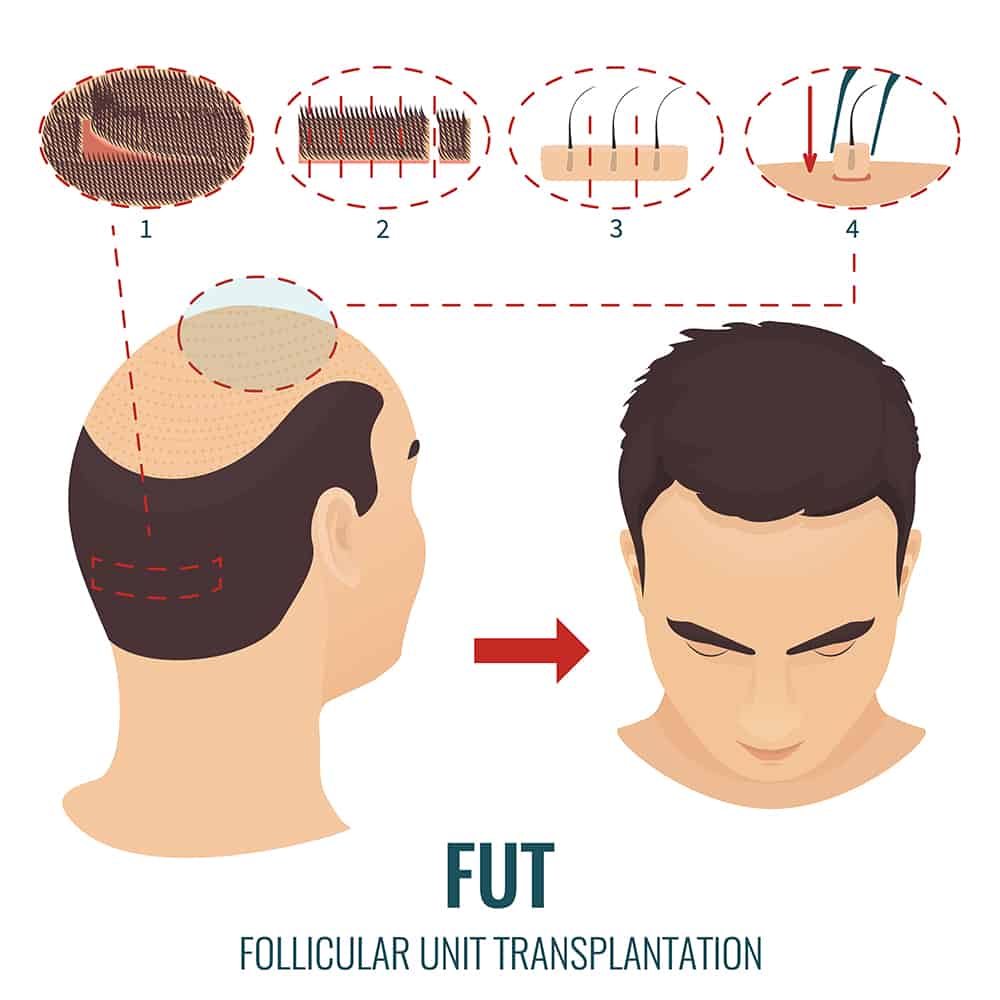
Follicular Unit Transplantation (FUT) is a hair transplant technique where a thin strip of hair-bearing scalp is removed from the donor area (usually the back of the head). The strip is then dissected under magnification into individual follicular units and transplanted into areas affected by hair loss.
FUT is commonly used to treat male pattern baldness (androgenetic alopecia), particularly in patients with significant hairline recession, crown thinning, or widespread scalp hair loss. Although patients are left with a thin, linear scar on the back of their head post-surgery, it is often recommended for patients with moderate to advanced hair loss who want maximum coverage because it preserves follicle integrity and maximises graft yield,
This hair transplant method remains a core treatment offered at our Birmingham hair transplant clinic, primarily being used in cases where patients do not wish to shave their donor area and maintain long hair after surgery. This makes it especially popular with women and transgender patients. Unlike follicular unit extraction (FUE), FUT does not require the entire donor area to be shaved.
All FUT procedures at the Birmingham clinic are performed by experienced GMC-registered surgeons, who are responsible for donor strip removal, wound closure, recipient site creation, and oversight of graft preparation and implantation.
Who Is FUT Best Suited For?
While minimally invasive treatments like FUE or DHI tend to be more common nowadays, an FUT hair transplant may be the right option for you if you fit into one of the following situations:
- Have advanced male pattern baldness – FUT is ideal if you require a high number of grafts (Approx 3,200+) in one session. In these situations, the benefit of reversing hair loss would outweigh the drawback of a visible strip scar.
- Have good donor density and scalp laxity – this allows for maximum extraction during the procedure itself.
- Wear your hair at a medium or longer length – having hair longer than a grade 3 (on barber’s clippers) is enough to hide the linear strip scar on the donor site. This makes the procedure popular for female and transgender patients.
At the Birmingham hair transplant clinic, your suitability for an FUT surgery will be assessed during your online or in-person consultation. Before your procedure, you will also have a pre-surgery consultation with one of our specialised FUT hair transplant surgeons.
We’ll help set your aims and expectations, and provide a fully personalised treatment plan and price quote. So, why not book a free consultation today?
FUT Hair Transplant Procedure in Birmingham
All FUT procedures are performed by the surgeons themselves at our Birmingham hair transplant clinic. The doctor is personally responsible for the donor strip extraction and incisions, as well as assisting hair transplant technicians with implantations.
Before your procedure at the Birmingham hair loss clinic, you will have a pre-surgery consultation where you will go through final preparations and hairline design with the surgeon. From there, local anaesthetic and saline will be administered into the scalp.
1. Donor Strip Removal
A narrow strip of hair-bearing skin is removed from the donor area at the back of the scalp, where hair is genetically resistant to DHT. The area is carefully closed using advanced suturing techniques to produce a fine, discreet linear scar. After your procedure, the stitches dissolve naturally, meaning you don’t need to come back to the clinic after your FUT surgery.
2. Graft Preparation
Once the surgeon has removed the strip of skin, technicians will then extract hair follicles (grafts) under a microscope. These grafts are then categorised according to the number of hair follicles present in each graft (singles, doubles, triples) and stored safely.
3. Recipient Site Creation
The surgeon creates tiny recipient sites in the thinning or balding areas using ultra-fine blades. Each incision is designed to match your natural hair direction, angle, and density for a realistic result. Incisions are a vital part of the hair transplant as they will largely dictate the final density and thickness of your result.
4. Graft Implantation
Follicular units are implanted individually, with single-hair grafts placed at the hairline and multi-hair grafts used behind for density. This part of the procedure is performed by the entire surgical team.
Once your procedure has been finished, you will have a post-surgery consultation where your surgeon will walk you through your aftercare instructions and recovery kit, as well as provide you with free access to our aftercare app.
Recovery & Hair Growth Timeline
All patients undergoing an FUT hair transplant at our Birmingham clinic receive comprehensive aftercare guidance, a recovery kit, and scheduled follow-up appointments at 2 weeks, 3 months, 6 months, and 12 months to monitor healing, progress, and final results.
Following surgery, the initial healing phase typically lasts 7 to 14 days. During this time, the donor and recipient areas begin to recover, with redness, tightness, and small scabs gradually settling as the scalp heals. As FUT surgery requires the excision of a small strip of skin, it is common to experience tightness on the back of the head in the first couple of weeks after surgery.
Between 2 and 6 weeks post-surgery, the transplanted hairs usually shed. This is a completely normal and expected part of the process and does not affect the long-term outcome of the transplant, as the hair follicles remain securely in place beneath the skin.
From around 3 to 4 months, new, permanent hair growth starts to appear. Hair continues to thicken and mature over the following months, with gradual improvements in density and coverage.
Final results are typically visible between 9 and 12 months, once the transplanted hair has fully grown and blended naturally with your existing hair. For patients who have had a hair transplant surgery on the crown, final results may take slightly longer to come through (up to 18 months).
After your FUT surgery at the Birmingham clinic, patients are also provided with a complimentary supply of hair loss medication (e.g. finasteride, minoxidil). This will help prevent further recession or thinning from occurring behind the hair transplant site.
Why Choose Our Birmingham FUT Hair Transplant Clinic?
Choosing our Birmingham FUT hair transplant clinic means placing your treatment in the hands of experienced professionals and receiving care that extends well beyond the day of surgery.
- GMC-registered surgeons & additional ISHRS accreditation
- Surgeon-led procedures only
- Local Birmingham aftercare & follow-ups
- Transparent pricing & finance options
Being treated locally in Birmingham allows for easier access to follow-up appointments, reduced travel during the recovery period, and ongoing clinical support whenever you need it. From your initial consultation through to your final results, our focus is on safe surgery, natural outcomes, and a clear, well-supported hair restoration journey.
FUT Hair Transplant Cost in Birmingham
The cost of an FUT hair transplant at our Birmingham clinic typically ranges between £4,000 and £8,000, depending on:
- Number of grafts required
- Size of the treatment area
- Hair thickness and donor density
- Complexity of hairline restoration
Your exact price is confirmed during your free consultation, with finance options available to spread the cost over up to 11 months. All you need to do is pay a £500 deposit to secure your date.
Book a Free FUT Hair Transplant Consultation in Birmingham
If you are considering an FUT hair transplant in Birmingham, Solihull, Dudley, or the West Midlands, the next step is a professional consultation with one of our patient advisors.
We will assess your suitability, discuss realistic outcomes, and provide a personalised treatment plan with no obligation.
📞 Phone: +44 121 751 1597
Frequently Asked Questions (FAQs)
An FUT hair transplant is performed under local anaesthetic, so the procedure itself is not painful. You may feel pressure or movement, but discomfort is minimal. Some tightness or soreness in the donor area may occur after surgery, which is usually manageable with standard pain relief.
Yes, FUT is suitable for women in specific cases, such as stable hairline recession or reconstructive hair restoration. However, not all women with diffuse thinning are suitable candidates. Before booking in with us, female patients all require a pre-surgery consultation with the doctor to determine eligibility for a procedure.
Initial recovery typically takes 10 to 14 days. At out clinic, stitches dissolve, negating the need to come back to the clinic. Most patients return to non-physical work within a week. If you have the option to work from home, then this is recommended. Final hair growth results are seen between 9 and 12 months.
Yes. FUT hair transplants are considered permanent. The transplanted follicles are taken from DHT-resistant areas of the scalp and retain this resistance after transplantation. While surrounding native hair may continue to thin, transplanted hair is designed to last long term.
Additionally, FUT surgery also leaves a permanent scar on the back of the head, which is visible with shorter hairstyles. If you are concerned about this, then an FUE hair transplant may be a more preferable option for you.
You may be suitable for FUT if you have good donor density, adequate scalp laxity, and moderate to advanced hair loss. FUT is particularly effective for patients requiring a large number of grafts in a single session. Suitability is assessed during consultation.
In cases of extensive hair loss, more than one procedure may be recommended to achieve optimal density while preserving donor resources. This will be discussed as part of your long-term treatment plan.
Make the best investment in yourself and find out more about how we can help eliminate hair loss for good!
Where to Find Us
Hair Transplant Birmingham is centrally located and easily accessible from across the Midlands.
Hair Transplant Birmingham
12-22 Newhall Street
Birmingham
B3 3AS
The clinic is a short walk from Birmingham New Street and Snow Hill stations. Easy access from the M6 and M5 motorways with several car parks nearby in the city centre.
Patient Testimonials
Aside from achieving fantastic results, we believe that keeping in touch with our patients before, during and after their hair transplantation procedure is paramount – it helps to keep our patients feeling calm and in control. We’re always on hand to provide guidance, support and aftercare advice. Time and again, our patients tell us that this is what sets us apart from other clinics.
You can read our great reviews of FUE hair transplants over on Google and Trustpilot